How Father Involvement in Child Empathy Shapes Your Child's Future
A Research-Backed Guide to Nurturing Kindness, Attachment, and Social Intelligence in Early Childhood
by Fatherhood United | www.fatherhoodunited.com
The Essential Role of Dads in Emotional Growth
For generations, popular culture framed fathers primarily as secondary caregivers, disciplinarians, or financial providers. Emotional nurture and social teaching were often viewed as the exclusive domain of mothers. However, modern developmental psychology and affective neuroscience tell a very different story. Today, rigorous meta-analytic research proves that fathers play an indispensable role in shaping their children's emotional intelligence, moral reasoning, and kindness.

When fathers engage deeply with their children from early childhood, they do far more than pass along practical life skills. They help construct the emotional blueprint that dictates how their children will treat others, form friendships, handle conflicts, and navigate life's challenges. At Fatherhood United (www.fatherhoodunited.com), we believe that every dad possesses the potential to raise caring, resilient, and empathetic leaders. Father involvement in child empathy is not just an added bonus in parenting; it is a core driver of lifelong social success
and psychological well-being.
Understanding Empathy: Head and Heart Working Together
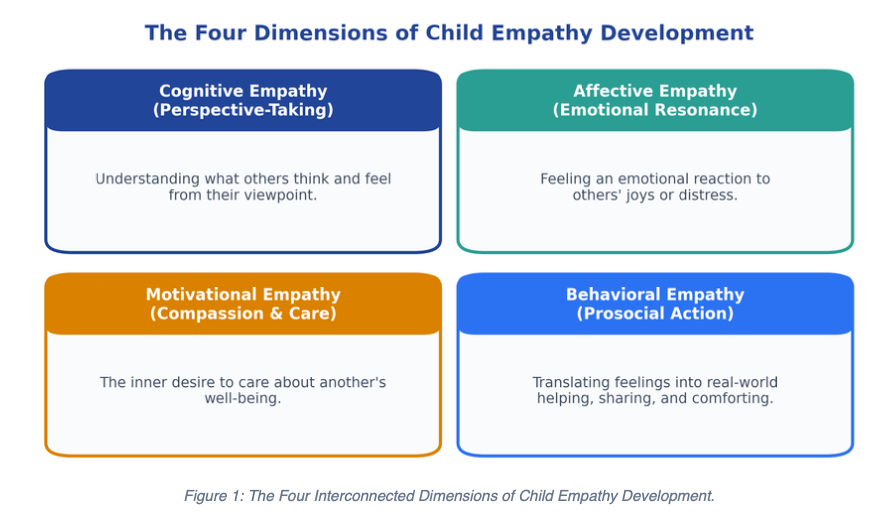
To understand how father involvement in child empathy works, it is helpful to break down what empathy actually is. Psychologists define empathy as the ability to recognize, understand, and share the emotional states of others while keeping a clear boundary between oneself and the other person (UNICEF, 2021). Far from being a single instinct, empathy is a multidimensional skill composed of four distinct components:
Cognitive Empathy (Perspective-Taking): The intellectual ability to see a situation from another person's point of view and understand what they might be thinking or feeling.
Affective Empathy (Emotional Resonance): The gut-level ability to feel an emotional reaction when witnessing someone else's pain, joy, or distress.
Motivational Empathy (Compassion): The inner drive and desire to care about another person's emotional state and wish for their well-being.
Behavioral Empathy (Prosocial Action): Translating internal feelings into real-world helpfulness, such as sharing a toy, comforting a crying friend, or standing up for a classmate.
Children who develop strong empathy skills show significantly higher social competence, build healthier peer relationships, and display lower levels of aggression and behavioral problems (Malti et al., 2016; UNICEF, 2021). They also enjoy higher subjective well-being and academic success. But how do children learn these crucial skills? The journey begins at home through the secure bonds they form with their primary caregivers, especially their fathers.
The Science of Father Involvement in Child Empathy
For decades, developmental studies focused almost exclusively on mother-child dynamics, largely neglecting the unique impact of fathers. Recent large-scale scientific reviews have corrected this imbalance, revealing that fathers exert a profound and independent influence on their children's socio-emotional development.
Father-Child Attachment and Prosocial Behavior
Attachment theory explains how the early emotional bond between a child and a parent creates an internal working model for all future relationships. When a father responds sensitively and promptly to his infant's distress, the child internalizes a profound sense of safety and trust.
A landmark meta-analysis conducted by Deneault et al. (2023) synthesized 35 studies on child-mother attachment (representing 4,611 children) and 6 studies on child-father attachment (representing 402 children). The researchers discovered that secure attachment to fathers significantly predicts positive child prosociality (r= .11), an effect size comparable in overall developmental impact to child-mother attachment security (r = .19). Crucially, the meta-analysis established that the strength of attachment effect sizes did not differ significantly based on parent gender.
Another comprehensive meta-analysis by van der Storm et al. (2021), examining 29 studies with over 14,600 children, evaluated the distinct contributions of maternal and paternal parenting behaviors using structural equation modeling. The findings confirmed that paternal warmth and positive control showed a statistically significant positive association with children's prosocial behavior (r = .10), performing on equal terms with maternal parenting (r = .12). High levels of warmth and low levels of harshness from both mothers and fathers consistently foster helping, sharing, and comforting behaviors in children.

The Protective 'Buffer Effect' of Secure Father Attachment
What happens when a child forms different attachment relationships with each parent? A groundbreaking Individual Participant Data (IPD) meta-analysis by Dagan et al. (2026), analyzing 16 studies and 1,585 children, examined how configurations of mother-child and father-child attachment predict social competence.
The research revealed that children who had insecure attachment relationships with both parents displayed significantly lower social competence compared to those who had at least one secure attachment (g = 0.20). Remarkably, children with a secure attachment to either their mother or their father performed equally well in social competence compared to children with two secure attachments. In other words, a secure attachment with a father acts as a critical protective buffer, shielding a child from the potential developmental risks of an insecure relationship elsewhere.
Furthermore, research by Deneault et al. (2021) demonstrated that insecure child-father attachment in early childhood directly predicts higher levels of externalizing behavior problems, such as aggression and defiance (r= 0.18), as well as internalizing problems like anxiety (r = 0.09). These effect sizes match those found in mother-child research, proving that a father's emotional availability is equally vital for preventing behavioral difficulties.
Parenting Styles That Build Strong Minds and Kind Hearts
While attachment forms the emotional foundation, a father's daily parenting style provides the active structure through which empathy is learned. Psychological research classifies parenting into four primary styles based on two main dimensions: Warmth/Support and Control/Demands (Heynen et al., 2021).
A comprehensive three-level meta-analysis by Heynen et al. (2021) analyzed 14 studies (representing 2,504 youth across 65 effect sizes) to determine how these parenting styles relate to child empathy. The findings offer a clear blueprint for fathers:
Authoritative Parenting (High Warmth, High Reasonable Control): Authoritative parenting was the only classical style that showed a robust, statistically significant positive association with youth empathy (r = .232). Authoritative fathers combine deep love, active listening, and warmth with firm, fair boundaries and clear expectations. This approach strongly fosters both cognitive empathy (r = .348) and affective empathy (r = .240).
Authoritarian Parenting (Low Warmth, High Harsh Control): Authoritarian fathers rely on strict obedience, harsh punishment, and low emotional responsiveness. The meta-analysis revealed no positive association with empathy (r = -.038). Harshness and power assertion model emotional dysregulation and create self-focused fear, preventing children from focusing on others' feelings.
Permissive Parenting (High Warmth, Low Control): Permissive fathers are loving and affectionate but fail to enforce consistent boundaries or discipline. This style showed no significant link to child empathy (r = .111). Without boundaries, children struggle with emotional self-regulation, which hinders empathy development.
Neglectful/Uninvolved Parenting (Low Warmth, Low Control): Uninvolved fathers provide neither affection nor guidance, posing severe risks for child emotional deficits and antisocial behavior.
The Power of Inductive Discipline
Why is authoritative parenting so effective in boosting father involvement in child empathy? The secret lies in a strategy called inductive discipline. When a child misbehaves (for instance, taking a toy from a playmate), an authoritarian father might yell or administer immediate punishment without explanation. An authoritative father using inductive discipline takes a different approach:
Points out the victim's distress: 'Look at Tommy's face. He is crying because he was still playing with that truck.'
Encourages perspective-taking: 'How would you feel if someone pulled that truck out of your hands while you were building your tower?'
Explains the logical consequences: 'When we grab toys, our friends feel hurt and do not want to play with us.'
Guides prosocial repair: 'Let us go ask Tommy how we can help him feel better and share the block set together.'
Research shows that inductive discipline directly stimulates the prefrontal cortex networks responsible for perspective-taking (Malti & Speidel, 2024; UNICEF, 2021). It helps children internalize moral rules and feel prosocial guilt (caring about harm done to others) rather than personal fear of punishment.
Father Intelligence and Daily Attachment Behaviors
How do a father's cognitive abilities translate into positive parenting in everyday life? A 2026 multi-informant study by Ji et al., examining 763 preschoolers and their parents, explored the link between parental intelligence (a parent's capacity to synthesize parenting knowledge and solve child-rearing problems), parental attachment behaviors, and preschoolers' social competence.
The study revealed several crucial insights for fathers:
Direct Correlation: Higher parental intelligence correlates strongly with child social competence (r = .605). Dads who actively seek out parenting knowledge, plan structured family routines, and reflect on their child's needs raise more socially competent kids.
The Mediating Pathway: Parental attachment behavior (showing active contact, expressing positive emotion, and providing warm physical affection) partially mediated this relationship, accounting for 39.4% of the total effect. This proves that intellectual knowledge alone is not enough; a father must actively translate his knowledge into daily, physical, and emotional bonding behaviors.
Cross-Gender Stability: Moderated mediation testing confirmed that parent gender did not alter this mechanism. The pathway from parental intelligence through attachment behavior to child social competence operates with equal strength for both fathers and mothers (Ji et al., 2026).
While mothers scored slightly higher on frequency of daily attachment contact in this sample (likely due to traditional caregiving divisions), fathers who practiced warm attachment behaviors achieved identical positive developmental outcomes in their children. These findings empirically challenge older views that mothers and fathers operate under fundamentally different emotional rules.
Practical Strategies for Fathers: Building Empathy at Home
Knowing the science behind father involvement in child empathy is empowering, but how can a busy dad implement these principles in daily family life? Here are four evidence-based practices that every father can adopt starting today:
Practice Active Emotion Labeling
Children are not born with a fully developed vocabulary for complex inner feelings. When a toddler throws a tantrum or a school-aged child shuts down, they are often overwhelmed by emotional states they cannot yet name. Instead of shutting down emotional displays with 'Stop crying' or 'It is not a big deal,' step in as an emotional co-regulator. Label the emotion gently: 'I see that you are feeling really frustrated because your tower fell over. It is okay to feel mad. Let us take a deep breath together and figure out how to rebuild it.' Research shows that when caregivers explicitly label emotions, it accelerates the child's neural transition from raw emotional distress to cognitive self-regulation.
Leverage Shared Storybook Reading
A meta-analysis on storybook reading demonstrated that dialogic reading contexts yield a massive positive effect on children's prosocial behavior (d = .69). Make bedtime reading an interactive empathy workout. Pause on pages where characters face dilemmas or distress. Ask open-ended questions: 'Look at the bunny's face. How do you think she feels right now? Why do you think she felt hurt when her brother did not share?' Discussing character motivations allows children to practice Theory of Mind in a safe environment, which directly boosts real-world perspective-taking.
Model Self-Regulation and Authentic Care
Children observe how their fathers handle frustration, anger, and interpersonal stress. A dad who stays calm under pressure models healthy emotional processing for his children. When you feel stressed after a tough day, talk through your coping strategy out loud: 'Dad had a really busy, stressful day at work, and I feel a little overwhelmed. I am going to sit quietly for five minutes and drink a glass of water so I can feel calm and enjoy our dinner together.' Longitudinal studies confirm that children with better emotion-regulation skills derive even greater benefits from parental warmth, creating a compounding upward trajectory of prosocial development.
Engage in Socially-Oriented Experiential Learning
A systematic review and meta-analysis of empathy interventions by Wu et al. (2024) revealed that Socially-Oriented approaches (interventions that involve live, collaborative interaction, peer mentalization, and shared helping) produce the highest and most sustained empathy gains (Mg = 0.60). This aligns with evaluations of universal programs like Roots of Empathy (ROE), which bring an infant and parent into classrooms to demonstrate emotional literacy and care, producing lasting reductions in aggression (d = 0.34 to 0.50; Schonert-Reichl et al., 2012; Lätsch et al., 2017). Take your children out into the community for hands-on, prosocial experiences. Help a neighbor shovel snow, volunteer at a local park cleanup, or prepare a care package for a sick family member. Behavioral empathy is best solidified when children actively perform prosocial actions rather than merely hearing about them abstractly.

The Lifelong Legacy of an Empathetic Father
Raising a kind, empathetic child is one of the greatest contributions a father can make to the world. The scientific evidence is clear and overwhelming: father involvement in child empathy builds resilient neural pathways, buffers children against emotional adversity, reduces behavioral problems, and fosters deep social competence.
When you choose to lead with warmth, enforce firm but fair boundaries, talk through emotional consequences, and remain physically and emotionally present, you are not just managing daily behavior; you are building a legacy of care that will influence generations to come. You are teaching your children how to be loving partners, loyal friends, supportive colleagues, and compassionate parents themselves.
Join Fatherhood United Today!
No father is meant to walk this developmental journey alone. Parenting in today's fast-paced world brings real challenges, and every dad deserves a supportive community, expert guidance, and practical tools to help his family thrive.

At Fatherhood United (www.fatherhoodunited.com), we are dedicated to empowering fathers with cutting-edge, evidence-based strategies, interactive workshops, peer support groups, and hands-on resources. Whether you are navigating the toddler years, supporting a school-aged child, or guiding a teenager, Fatherhood United is your ultimate home for growth and brotherhood.
Ready to level up your fatherhood journey?
Visit Us Online: Head to www.fatherhoodunited.com to access our free resource library, expert articles, and video guides.
Join Our Community: Sign up for a Fatherhood United membership today to connect with thousands of committed dads across the nation.
Subscribe to Our Newsletter: Get weekly evidence-based parenting tips, action plans, and podcast episodes delivered straight to your inbox.
Become the dad your children deserve. Join Fatherhood United today, and let us build a kinder, stronger future together!
References
Dagan, O., Schuengel, C., Madigan, S., & Cummings, M. (2026). Configurations of mother-child and father-child attachment relationships as predictors of child social competence: An individual participant data meta-analysis. Attachment & Human Development, Pre-print publication.
Deneault, A. A., Bakermans-Kranenburg, M., Groh, A. M., & Madigan, S. (2021). Child–father attachment in early childhood and behavior problems: A meta-analysis. New Directions for Child and Adolescent Development, 2021, 15–30.
Deneault, A. A., Hammond, S. I., & Madigan, S. (2023). A meta-analysis of child–parent attachment in early childhood and prosociality. Developmental Psychology, 59(2), 236–255.
Heynen, E., Van der Helm, P., Simon, E., Stams, G. J. J. M., & Assink, M. (2021). Parenting style and empathy in youth: A three-level meta-analysis. In D. Jolliffe & D. P. Farrington (Eds.), Empathy versus offending, aggression and bullying: Advancing knowledge using the Basic Empathy Scale (pp. 43–60). Routledge.
Ji, X., Zhang, Y., Zuo, Y., Ji, C., Xu, Y., Jin, P., & Wang, M. (2026). Parental intelligence and preschoolers' social competence: The mediating role of parental attachment behavior and the moderating effect of parent gender: A multi-informant study. Frontiers in Developmental Psychology, 4, Article 1814467.
Lätsch, D., et al. (2017). Evaluation of the Roots of Empathy program in Switzerland, years 2015 to 2017. Jacobs Center for Productive Youth Development, University of Zurich.
Malti, T., Chaparro, M. P., Zuffianò, A., & Colasante, T. (2016). School-based interventions to promote empathy-related responding in children and adolescents: A developmental analysis. Journal of Clinical Child and Adolescent Psychology, 45(6), 718–731.
Malti, T., & Speidel, R. (2024). Development of prosociality and the effects of adversity. Nature Reviews Psychology, 3(8), 524–535.
Schonert-Reichl, K. A., Smith, V., Zaidman-Zait, A., & Hertzman, C. (2012). Promoting children's prosocial behaviors in school: Impact of the “Roots of Empathy” program on the social and emotional competence of school-aged children. School Mental Health, 4(1), 1–21.
UNICEF Office of Research – Innocenti. (2021). How empathizing develops and affects well-being throughout childhood (Innocenti Working Paper 2021-13). UNICEF.
van der Storm, L., Van Lissa, C. J., Lucassen, N., & Keizer, R. (2021). Maternal and paternal parenting and child prosocial behavior: A meta-analysis using a structural equation modeling design. Marriage & Family Review, 57(7), 589–618.
Wu, Z., Wang, S., et al. (2024). Categories of training to improve empathy: A systematic review and meta-analysis. Psychological Bulletin, 150(7), 789–812.


Comments